
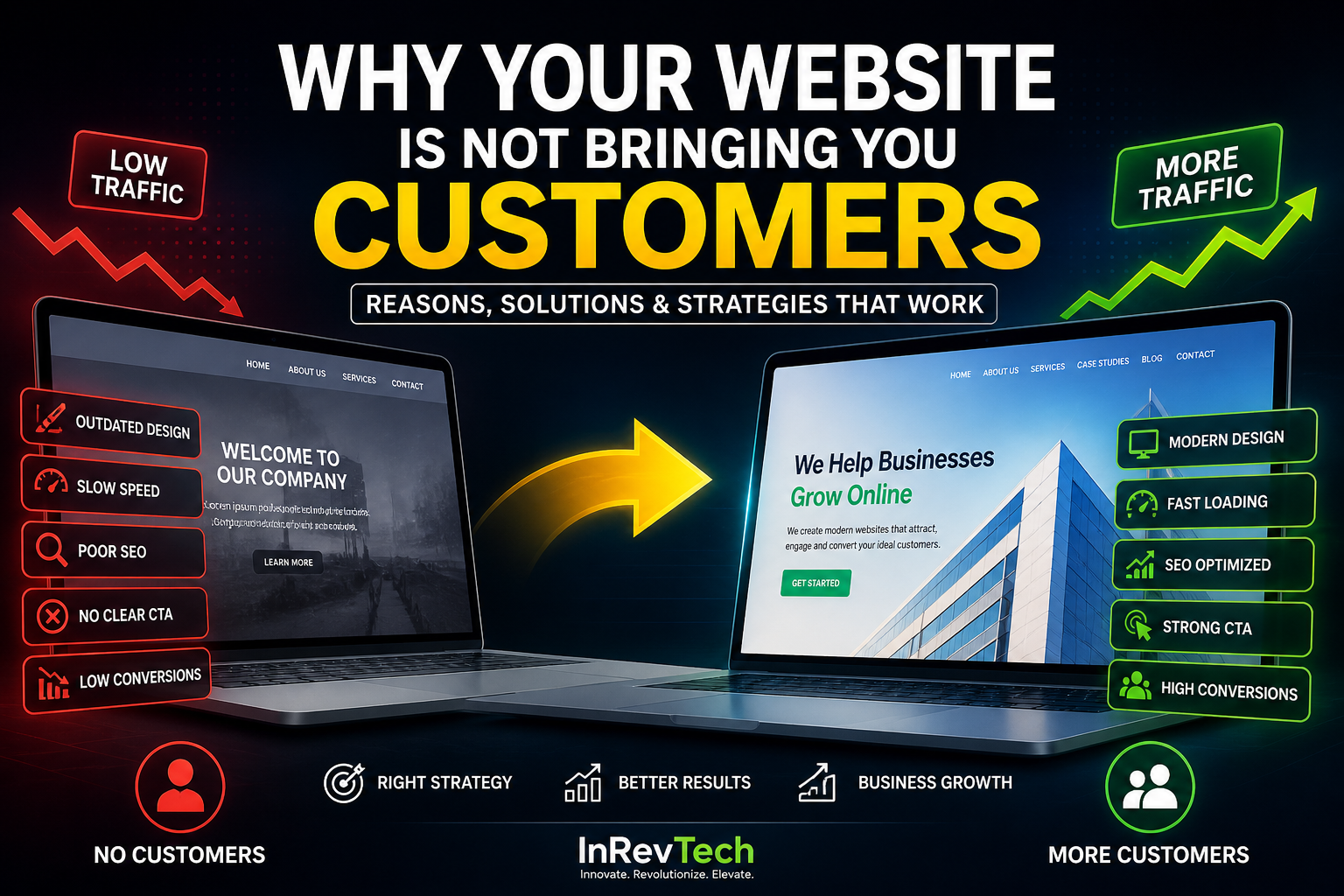
Why Your Website Is Not Bringing You Customers
Many businesses today have a website, but very few are actually getting customers from it.
If your website is not bringing you customers, you are not alone. This is one of the most common problems businesses face. The issue is rarely just traffic. In most cases, the problem is how the website is designed, structured, and presented.
A website should not only exist. It should attract, convince, and convert visitors into real inquiries.
If that is not happening, something is broken.
What a Website Is Supposed to Do
Before fixing the problem, it is important to understand the role of a website.
A business website should:
- clearly explain what you do
- build trust quickly
- guide visitors to take action
- support your marketing efforts
- help you appear in search results
- convert visitors into leads or customers
If your website is not doing these things, it is not working as a business tool.
1. Your Website Message Is Not Clear
Visitors should understand your business within seconds.
If your homepage is vague, confusing, or full of generic statements, people may leave without taking action.
A strong website clearly explains:
- who you help
- what you offer
- what problem you solve
- why someone should choose you
Clarity is one of the biggest drivers of conversion.
2. You Are Attracting the Wrong Audience
Sometimes the problem is not your website. It is the type of visitors coming to it.
If your content, SEO, or marketing attracts people who are not your target clients, they will visit your website but not convert.
Your website content should match your ideal customer’s needs, problems, and expectations.
3. Your Website Looks Unprofessional
People judge businesses quickly.
If your website looks outdated, poorly designed, or inconsistent, visitors may assume your business is not reliable.
Even if your services are good, poor design can reduce trust and push people away.
A professional design builds confidence and encourages visitors to stay longer.
4. Your Website Is Not Mobile-Friendly
A large percentage of users visit websites from their phones.
If your website is difficult to use on mobile, you may lose potential customers before they even understand your offer.
Common issues include small text, broken layouts, slow loading, and hard-to-use forms.
A mobile-first website improves user experience and increases conversions.
5. Your Website Loads Too Slowly
Speed matters.
If your website takes too long to load, visitors may leave before seeing your content.
Slow websites also create a poor first impression and reduce trust.
Improving speed through better hosting, optimized images, and clean code can make a big difference.
6. Your Website Has Weak Calls to Action
Visitors need direction.
If your website does not clearly tell people what to do next, they may leave without taking action.
Strong calls to action should be visible, clear, and repeated across your website.
Examples include:
- Request a Quote
- Contact Us
- Book a Consultation
- Talk to InRevTech
Your website should guide visitors, not leave them guessing.
7. Your Website Does Not Build Trust
People need reasons to trust your business.
If your website does not include testimonials, case studies, real examples, or clear information about your business, visitors may hesitate to contact you.
Trust-building elements help reduce doubt and increase confidence.
8. Your Website Is Not Optimized for Search Engines
If your website is not bringing customers, it may not be visible in search results.
Poor SEO means fewer people find your website when searching for your services.
SEO improvements include:
- better page titles
- optimized content
- clear headings
- internal linking
- faster speed
- relevant keywords
Without SEO, your website may remain hidden.
9. Your Content Is Not Persuasive
Good content should not only inform. It should convince.
If your website content is too basic, unclear, or generic, it may fail to communicate your value.
Strong content explains benefits, addresses pain points, and shows how your service helps.
Visitors should feel confident enough to take the next step.
10. Your Website Is Not Designed to Convert
Many websites are built to look good, not to convert.
A high-converting website is structured to guide users step by step.
It includes:
- clear messaging
- logical page flow
- strong calls to action
- trust signals
- simple navigation
- focused content
If your website is not designed for conversion, visitors may leave without becoming customers.
How to Fix a Website That Is Not Bringing Customers
Fixing your website requires more than small adjustments.
You may need to improve:
- your messaging
- your design
- your content
- your SEO
- your speed
- your mobile experience
- your conversion strategy
In many cases, the best solution is a complete or partial redesign focused on business results.
The Role of SEO and User Experience
Search engines reward websites that are useful, clear, and easy to navigate.
Improving user experience and SEO together can increase both traffic and conversions.
Better structure, clearer content, faster loading, and mobile optimization all contribute to better results.
How InRevTech Can Help
InRevTech helps businesses turn underperforming websites into powerful tools for growth.
We focus on strategy, design, SEO, content, and user experience to help your website attract the right visitors and convert them into customers.
If your website is not bringing you customers, we can help you identify the problem and fix it.
Final Thoughts
A website that does not bring customers is not just ineffective. It is a missed opportunity.
The good news is that most website problems can be fixed with the right approach.
By improving clarity, design, SEO, and conversion strategy, your website can become a strong asset for your business.
Need help turning your website into a client-generating machine? Talk to InRevTech today and let’s build a website that works for your business